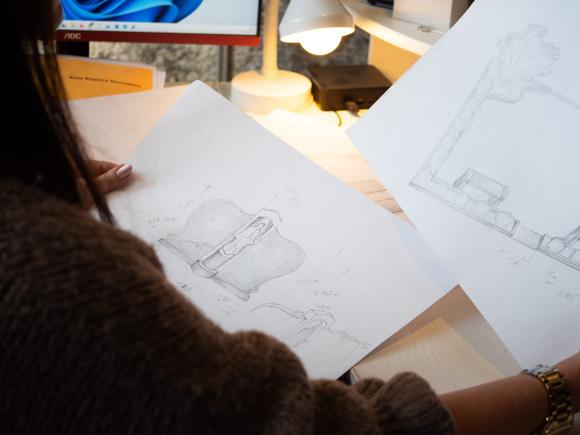
Grave landscaping is not only a question of appearance – it also has a practical purpose. The right grave surface helps the grave stay neat for a long time and makes it much easier to look after.
Today, instead of traditional sand, a range of solutions is used – from decorative chippings to granite slabs. Each option has its own characteristics, costs and care requirements.
Let us look at which grave surfaces are available, how they differ and how to choose the most suitable solution. We will also look at the materials most often used for grave landscaping in Latvia.
Grave sizes and types in Latvia
Latvia has uniform standards for grave sizes. In rural areas there are sometimes departures from these dimensions, but grave landscaping projects most often use the standard sizes, as this allows the work to be planned and costed more accurately.
When planning a family grave, people usually choose a plot for two or more burials. This makes it possible to keep a consistent style for the grave and to avoid further complications in the future.
Some open cemeteries in Riga, such as Bolderāja New Cemetery and Jaunciems Cemetery, also allocate single graves.
For the burial of cremation urns, on the other hand, there are usually no strict limits on the number of urns in one grave.
Standard grave sizes
| Graves for coffins | Width (m) | Length (m) | Area (m²) |
| Single | 1.75 | 3.00 | 5.25 |
| Double | 2.50 | 3.00 | 7.50 |
| Triple | 3.00 | 3.00 | 9.00 |
| Quadruple | 4.00 | 3.00 | 12.00 |
| Graves for urns | Width (m) | Length (m) | Area (m²) |
| Single | 1.50 | 1.50 | 2.25 |
| Double | 2.50 | 1.50 | 3.75 |
| Triple | 3.50 | 1.50 | 5.25 |
| Quadruple | 4.50 | 1.50 | 6.25 |
The size of the grave directly affects:
- how many elements can be placed on it
- whether the grave will be easy to maintain
- how the design of the grave will look as a whole
Before landscaping a grave, we recommend reading the Riga State City Municipality's binding regulations on the operation and maintenance of cemeteries.
What grave surfaces are there?
When planning grave landscaping, it is important to think ahead not only about the appearance, but also about the practical aspects that will affect the condition of the grave in the long term.
The main criteria for choosing:
- ease of care – how much time and effort will be needed to maintain the grave
- longevity – how well the material withstands the climate, rain and snow, and changes in temperature
- appearance – how well the grave surface goes with the monument and the overall design of the grave
- ease of restoration – how easily the grave can be put back in order after a further burial or after the ground has settled
It is also important to bear in mind that different grave surfaces behave differently over time. Some need regular renewal, while others keep their appearance for years but are more difficult to take up.
If you would like to choose the most suitable surface for a grave quickly and without unnecessary difficulty, you can contact SoulGarden's consultants - we will help you find the best solution, taking into account the grave, your budget and the care requirements.
Below we look at the most popular types of grave surface, their properties, and the advantages and disadvantages of each solution.
White washed sand or gravel

White washed sand and gravel are a classic solution for grave landscaping and have been used in Latvia for many years.
This grave surface is still popular because it is easy to obtain and simple.
Advantages of a sand surface:
- affordable price - one of the most economical grave surfaces
- simple care - the surface can easily be levelled with a rake
- practical - a burial can be carried out without complications
- easy to restore - the grave can be put in order quickly after the ground settles
- However, when choosing a sand surface for a grave, its particular characteristics in use should also be taken into account.
Disadvantages of a sand surface:
- in the rain, sand splashes up and soils the monument and borders
- regular care and renewal of the surface are needed
- without borders, the sand mixes with the soil and loses its neat appearance
- to keep its light colour, the surface has to be topped up regularly
- without additional protection, weeds grow quickly
When laying it, it is advisable to put geotextile under the sand - this slows the growth of weeds and makes caring for the grave easier.
It is important to understand that, despite the lower initial cost, a sand grave surface needs regular maintenance in the long term, which increases the investment of both time and work.
Dolomite chippings or pebbles

Fine dolomite chippings or pebbles are a more modern solution for a grave surface, creating a light, neat surface while being more practical in use.
This grave surface is often chosen as an alternative to sand - it looks tidier and needs less care.
Advantages of dolomite chippings:
- they do not splash up in the rain, so the monument and borders stay cleaner
- they keep their structure and colour longer than sand
- the surface can be levelled and tended with a rake
- a versatile solution - they can be used on their own or combined with sand
In practice, a mixture of chippings and sand is often used – this reduces splashing and over time forms a denser, more stable surface.
Disadvantages and particular characteristics:
- the cost is higher than for a sand surface
- borders are needed so that the material does not mix with the soil and paths
- the surface has to be restored after a burial
- taking it up and relaying it requires additional work
To make the grave surface last longer and easier to look after, it is advisable to:
- use geotextile under the chippings to reduce the growth of weeds
- install granite or concrete borders
- plan in advance for the surface to be taken up in the event of future burials

During a further burial, the chippings are usually removed together with the geotextile, and once the work is finished the grave is restored. This takes additional time and cost, which is important to consider when choosing this grave surface.
Overall, dolomite chippings strike a good balance between practicality and a neat appearance, and they suit those who want a more durable solution than sand without significantly increasing the budget.
Granite chippings

Granite chippings are one of the most popular grave surface solutions, combining good looks and longevity. This grave surface is often chosen when it is important to keep the grave looking neat without constant renewal.
Granite chippings go well with monuments, borders and other granite elements, making it possible to create a unified and visually harmonious grave design.
Advantages of granite chippings:
- an attractive, contemporary appearance
- combine well with granite monuments and borders, keeping a unified style
- a long-lasting solution – the surface keeps its appearance for a long time
- additional weed control products can be used
An important condition is laying geotextile and installing borders, so that the grave surface does not mix with soil or sand.
Disadvantages and care requirements:
- care is more complicated than for sand surfaces
- gentle cleaning with soft rakes or brushes is needed
- the surface is easiest to clean in dry weather
- needles, leaves and other debris must be cleared regularly
Soft brushes and blowers are usually used to look after the grave, collecting leaves, needles and small debris.
If a further burial is needed:
- the surface is removed together with the geotextile
- once the work is finished, the grave is restored
- it is usually necessary to top up the chippings
This increases both the amount of work and the maintenance costs, which is important to consider when choosing this grave surface.
Overall, granite chippings are an attractive and relatively affordable solution for those who want a beautiful, well-kept grave and are prepared to give more attention to its care or to entrust it to specialists.
Concrete paving

Ordinary concrete paving is a practical solution for a grave surface or for landscaping the surrounding area, and it makes caring for the grave considerably easier. This surface can be used over the whole area of the grave or in part - for example, to create a path or a small paved area by the monument.
Combined with granite elements, especially black granite monuments, paving looks neat and harmonious. The contrast of light grey paving with dark elements makes it possible to create a restrained, well-kept grave design. The surface is also easy to keep clean - a dry broom or brush is enough to keep it tidy.
Advantages of concrete paving:
- makes caring for the grave considerably easier
- easy to clean without special products
- a neat, well-kept appearance
- combines well with granite elements
Disadvantages and care requirements:
- it has to be taken up in the event of a further burial
- once the work is finished, the surface has to be relaid
- the ground may settle and become uneven
- good-quality professional laying is required
The cost of this grave surface is usually in the mid-price range, as not only the price of the material but also the quality of the laying has to be taken into account. In cemeteries, laying paving is more complicated than for ordinary pavements or paths - the base must be carefully prepared and the borders correctly installed so that the grave surface keeps its shape for a long time and deforms less.
If a new burial takes place in the grave, the paving must be carefully taken up and put back once the work is finished. If the ground settles, hollows may form, which have to be levelled by relaying the surface.
Split granite paving

In grave landscaping, natural stone - granite or fieldstone - is used most often. It is a material that makes it possible to create a long-lasting and visually complete grave design.
When creating a composition, people usually choose a contrasting combination of two shades of granite, or one shade with different textures, to give the design depth and character.
Split granite paving is particularly suited to such solutions. Its split texture goes harmoniously with polished borders and monuments, creating a neat and well-considered overall look. Compared with concrete paving, this grave surface looks more striking and is often used in projects where appearance and a unified style matter.
Advantages of split granite paving:
- an attractive and striking appearance
- goes harmoniously with granite monuments and borders
- a long-lasting and durable material
- suitable for individual design solutions
Disadvantages and care requirements:
- higher cost compared with concrete paving
- in the event of a further burial, it has to be taken up and relaid
- the ground may settle, requiring the surface to be restored
- the surface must periodically be treated with moss-control products
Split granite paving costs more than concrete paving, but this is offset by the longevity of the material and its appearance, which lasts for many years.
Our recommendation – create a unified design for the grave and use paving only in part, for example as a path or a small paved area by the monument.
Heat-treated granite slabs

Granite slabs over the whole area of the grave are a practical and long-lasting solution for grave landscaping.
Thanks to heat treatment, the granite surface becomes rough and non-slip, which is especially important in wet weather. At the same time, the colour of the granite looks lighter and more natural than on polished surfaces.
This grave surface is more expensive, but it stands out for its ease of care and keeps its neat appearance for a long time.
Advantages of this surface:
- non-slip surface
- longevity
- easy care
- a neat, visually unified and finished appearance
Disadvantages and particular characteristics:
- higher cost
- it has to be taken up in the event of a further burial
If necessary, the slabs can be carefully removed and reinstalled once the work is finished, provided the installation is carried out by specialists.
Polished granite slabs

Polished granite slabs are one of the most expensive solutions in grave landscaping. This grave surface creates a neat and visually complete impression that lasts for many years. Granite is weather-resistant, does not fade and does not need frequent care.
Despite the higher cost, this solution pays for itself through its longevity and simple maintenance. Even if the grave is visited less often, it keeps a well-kept appearance.
Care is minimal - it is enough to rinse the surface with water from time to time and wipe it with a soft cloth.
Advantages of this surface:
- an attractive and elegant appearance
- longevity
- minimal care requirements
Disadvantages and care requirements:
- high cost
- the surface can become slippery in wet weather
This grave surface is particularly suitable for those who want to keep the grave looking neat without regular care.
Additional landscaping elements
In addition to the main grave surfaces, it is also important to consider other elements that affect both the appearance of the grave and how easy it is to look after:
- borders (concrete or plastic) - help to hold the surface in place and give the grave a neat outline
- geotextile - reduces the growth of weeds
- mulch (coloured or natural) - suitable for planted areas
- decorative stones and fieldstones - complement the design and give the grave character
By combining these elements correctly, it is possible to create a grave that is not only neat in appearance but also easy to look after.
How to choose the most suitable solution
The choice of grave surface depends on several factors.
1. How often the grave is visited
- if the grave is visited rarely – granite slabs or granite surfaces will be more suitable
- if the grave is visited regularly – more natural surface solutions can also be chosen
2. Budget
- economical solution – sand
- medium budget – chippings or paving
- higher budget – granite slabs
3. Long-term perspective
It is important to consider in advance:
- a possible further burial
- the settling of the ground
- long-term care costs
Advice and help from SoulGarden
If you are not sure which grave surface to choose, or you want the grave to be landscaped to a high standard from the very start, it is advisable to consult specialists.
SoulGarden not only helps you choose the most suitable solution for the grave, but also provides the full grave landscaping process - from the idea to the finished result.
We can help to:
- choose the most suitable grave surface, taking into account budget, care and design
- develop the overall design of the grave – monument, borders, surface and planting
- lay various surfaces – chippings, paving, granite slabs
- install or replace borders
- repair and restore existing surfaces
- provide professional grave care and cleaning
We work throughout Latvia and also help clients who live abroad, providing photo reports at every stage of the work.
Contact us for a consultation and to find out which solution will be best suited to your particular grave.