For people who have lost a loved one, choosing a monument is in most cases a difficult and emotionally heavy decision. Relatives often feel confused and emotionally vulnerable. At such a time it is especially important not only to commemorate the departed in stone, but to do so thoughtfully and to a high standard.
Yet when it comes to landscaping a grave and making it neat and cared for, people often come across conflicting information and are unsure whom to trust.
One of the most common problems is the question of the right time to install a monument. It is still widely believed that a monument may only be installed a year after the funeral, because one has to wait for the ground to settle naturally. From a professional point of view this is not entirely correct — such an assumption often only delays the process and causes additional inconvenience.
The SoulGarden team has been working in monument making and monument installation since 2002.
Our aim is to help you make a considered decision and avoid technical shortcomings or unnecessary expense. So that the wish to put a grave in dignified order does not become an additional source of stress, we recommend paying attention to the following professional tips.
Tip 1: do not postpone grave landscaping – a monument can be installed after as little as 40 days

Many families put off choosing a monument indefinitely, believing that there are strict religious or technical restrictions on installing a monument earlier.
“Traditions” are often understood to mean folk beliefs or religious customs – for example, the belief that for the first year there should be only a wooden cross on the grave, and that a heavy monument may “disturb the peace”. Also especially widespread in Latvian culture is the observance of the so-called time of peace: from November to April people try not to disturb the earth and the departed with landscaping work.
From a spiritual point of view, however, there are no strict prohibitions on landscaping a grave. What matters most is preserving the memory and showing respect.
Technical restrictions, on the other hand, are mainly related to the weather and the season. In winter, installing a monument is difficult in many cemeteries, as frozen ground does not allow concrete work to be done properly or the necessary structural stability to be ensured.
In the warm season, however, the work can be done much sooner than after waiting a whole year for “the ground to settle”. Based on our many years of experience of when to install a monument, we can confirm that technically a monument can be installed about 40 days after the burial, because the monument is not placed directly over the burial itself. By then the withered flowers and wreaths have usually been removed, and the grave is ready for planning and landscaping.
It is important to understand the professional approach: a monument is practically never installed on the loose soil over the burial. It is mounted at the head of the grave on stable, undisturbed ground. If the grave is fully landscaped – with borders, a monument and a surface – the base of the monument is securely set in concrete in the rear structure of the borders. This creates a stable and long-lasting foundation for both the monument and the whole grave structure.
A professional approach means you do not have to wait for years, but can create a neat and dignified place of remembrance in good time, where temporary solutions are replaced by high-quality granite materials and a long-lasting memorial design.
Tip 2: rely on official regulations, not on myths about the ground settling in the first year

One of the most widespread beliefs holds that a monument cannot be installed in the first year after the funeral because the grave has to “settle”. From a technical point of view this is not entirely correct. As we mentioned above, a monument is installed on a foundation structure that rests on undisturbed, stable ground. The actual settling of the ground over the burial itself happens gradually over several years. The process of the coffin decomposing and the ground settling usually takes from 3 to 7 years, and in the case of solid wood coffins, such as oak, up to 10 years. This means that waiting exactly one year does not in itself bring any significant technical advantage for installing a monument.
To read about ground settlement and when a grave border can be installed, see the article When can a grave border be installed after a recent burial?
So why is the myth of “waiting a year” still so widespread? The reason is more often related not to the properties of the ground but to administrative regulations and emotional considerations.
1. The legal aspect and local council regulations
Many people do not know that the term “one year” often appears in official cemetery maintenance regulations – not as a ban on carrying out work, but as the deadline by which the grave must be put in order. For example, the binding regulations on the operation and maintenance of cemeteries in Gulbene Municipality state:
«Within one year of the burial, the person responsible for the grave must arrange the grave and continuously ensure that it is properly maintained.»
This means that the local council expects grave landscaping and the choice of monument to be completed no later than within a year of the burial, not only after a year has passed.
2. Emotional and practical considerations
A year often becomes a psychological threshold at which the initial grief gradually gives way to calmer remembrance. During this time it often becomes easier for relatives to make considered decisions about the monument's design, the materials and the overall design of the grave. This period is also often when inheritance matters are settled or funds are gradually saved for making and installing the monument.
However, it is important to consider the practical side too: if ordering the monument is postponed for a year, the actual installation may be pushed back by a further 6-8 months because of the seasonal workload and the production queue. That is exactly why we recommend starting to plan grave landscaping and the choice of monument in good time, based on professional experience, official regulations and rational considerations rather than myths.
Tip 3: plan the project at least six months before installation to avoid haste and seasonal queues

Many people think that installing a monument is a quick process that can be sorted out in a few weeks. In practice, developing and carrying out a high-quality grave landscaping project requires careful and time-consuming preparation. It is important to consider three main factors: the weather, the workload of the stone workshop, and the delivery times of materials or accessories for the specific order.
Seasonality and weather Grave landscaping work – concreting, reconstruction and monument installation – is closely tied to the season. The active working period usually begins in mid-April and ends in mid-November, shortly before Candle Night (Svecīšu vakars). During the rest of the year, low temperatures, prolonged rain and frozen ground often make proper installation difficult.
Why does making a monument take so long? At the heart of a professional approach is the fact that most of the work is done not at the cemetery but in the stone workshop. Even if a standard monument design is chosen and the necessary elements are in stock, agreeing a detailed design takes time. Careful thought is given to:
- the type of stone finish
- the fonts and layout of the inscriptions
- the choice of accessories and additional elements for the overall grave ensemble
If the chosen monument involves a rarer type of granite or an individual design, the lead times become considerably longer. Delivery of certain materials can take up to three months, while making and preparing an individual memorial complex can take up to six or seven months, not counting the installation work.
Our advice: if you want the grave to be fully in order by a particular date or the start of the season, it is best to begin planning the project in good time. If the burial took place in winter, spring or summer, the best time to order the project is autumn. This allows all the elements to be prepared without haste over the winter and the monument to be installed among the first jobs at the start of the season, as soon as the weather is suitable.
Tip 4: landscape the grave in stages to spread the budget sensibly

Grave landscaping is often a serious financial investment. Wanting to save money, people sometimes make hasty decisions that later lead to extra costs and the need to redo work that has already been done. That is why we recommend starting any project not with construction work but with a clear plan and a well-thought-out technical solution.
The main principle – design first, then the work
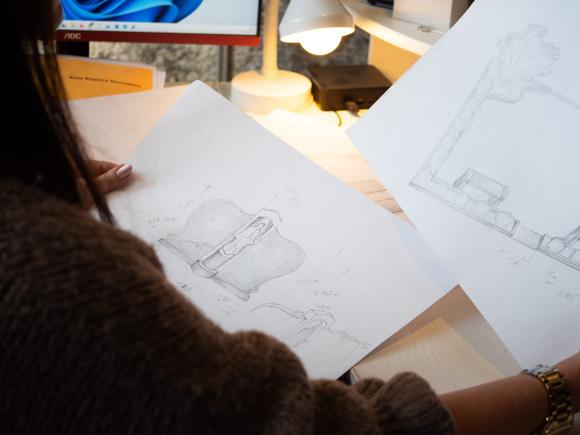
The first step is a consultation with a qualified specialist. A professional will help you choose the most suitable monument, select the right type of stone and accessories, and prepare an accurate design for the grave. A detailed plan helps to avoid significant mistakes.
The most common mistakes
-
Mistake no. 1 – installing the monument before the foundations are built: If the monument is installed before the concrete work is done, it later becomes difficult to build the borders or the rest of the structure properly. In such cases the monument often has to be dismantled and reinstalled. Without dismantling it, it is technically almost impossible to add borders or other elements correctly without damaging the foundation structure that has already been built.
-
Mistake no. 2 – poor-quality DIY concreting: If the base or perimeter is built unevenly, granite slabs or borders cannot be installed on it accurately. As a result, the structure has to be completely rebuilt or the earlier mistakes corrected, which often costs considerably more than having the work done professionally from the start.
How can a grave be landscaped in stages?
Dividing the work into several stages is perfectly normal practice, as long as it is based on a professional plan prepared in advance. For example:
- in the first season, the foundations can be built and the concrete work done;
- in the second season, the monument and the granite finishing can be installed.
The advantages of SoulGarden's all-in-one approach
Although grave landscaping can be carried out in stages, ordering the full project at once is often the more cost-effective solution in the long run. By ordering the whole ensemble at once, you get:
- Lower logistics costs – there is no need to arrange delivery of materials and call-outs of the installation team several times
- A unified technical and visual solution – the monument, borders and slabs are made from the same batch of stone, ensuring identical colour and texture
- Flexible payment terms – understanding the financial scale of such projects, we offer the option of spreading payment over up to 12 months with no additional interest
This approach makes it possible to achieve high-quality monument installation and grave landscaping without putting undue financial pressure on the family budget.
Tip 5: designing family graves – how to arrange several names on one monument

With family graves the question often arises – is it possible to commemorate four, five or even more loved ones on one shared monument, without placing several separate monuments? The answer is yes, it is possible. In such projects, however, the technical parameters, proportions and visual composition become especially important.
The main principle – legibility of the inscriptions
For a family monument to be a good choice, it is important to calculate the size of the inscriptions correctly. In our experience, setting out one person's details – first name, surname and years of life – clearly and legibly requires at least 18-20 centimetres of height.
In addition to the text itself, sufficient spacing between the inscriptions must also be allowed for. Otherwise the information visually merges and becomes hard to take in. Several important conclusions follow from this.
-
Height of the monument: If the details of four or five people are to be included, the monument slab usually needs to be at least 1.20 metres high. On a smaller stone the text would have to be made too small, and it would no longer be easy to read from the cemetery path.
-
Width and overall composition: The width of the monument is chosen individually, taking into account the length of the surnames and the overall composition. In practice, one of the most successful solutions is often a three-part composition, which allows the inscriptions to be arranged harmoniously and visually closes off the rear of the grave.
Balancing design and budget
It should be borne in mind that a granite slab more than one metre high is a massive and costly structure. If the budget is limited, alternative solutions are also possible.
- A combined solution: The family surname or a shared family element can be placed on the central monument, while the names of individual people are engraved on small memorial plaques placed beside the monument or integrated into the horizontal part of the grave.
- A more economical option: One slab for two people is also a practical solution. It helps keep the overall appearance neat and visually calm while reducing costs.
In larger family graves, however, a single larger and architecturally unified monument usually looks much more harmonious and attractive than a combination of several small memorial plaques.
Installing a monument of this scale requires careful design in advance, so that the monument's proportions, font sizes and the overall design of the grave work together harmoniously.
A dignified memorial begins with the right choice
Grave landscaping is not just a technical or construction process. It is a personal and emotionally significant step that completes an important stage of saying goodbye to a loved one. As we have seen, installing a monument does not always need to be postponed because of folk beliefs about “waiting a year”. What matters most is a professional approach, high-quality materials and a well-thought-out technical solution.
Behind every long-lasting, well-designed memorial there is always careful preparation. The sooner project planning begins, the more time can be devoted to the details, the choice of materials and high-quality workmanship. It also allows the family itself to go through this process more calmly and without unnecessary haste.
If you have questions or need help with something as important as making a monument, trust the specialists. Since 2002 the SoulGarden team has been helping families create well-considered, long-lasting memorials that preserve the memory of their loved ones for many years.
We will provide a detailed consultation, help you develop a professional technical design and find the most suitable solution for your budget – from understated monuments to large family memorial ensembles. We also offer the option of spreading payments over up to 12 months with no additional interest, so that the project can be carried out without excessive financial strain.
SoulGarden – with respect for the past and a responsible view of the future.