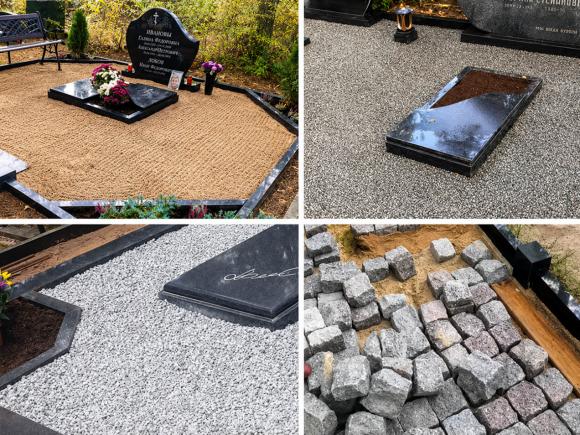
The era of monumental, massive monuments that was typical of the last century is gradually passing. Contemporary grave design in Latvia means creating a unified and harmonious memorial ensemble, in which the monument, border, surface and plants complement one another.
SoulGarden provides professional services in all cemeteries in Riga, Jūrmala and other regions of Latvia. We know the local terrain, the soil composition and the particular flora of each cemetery well, which allows us to create sustainable and aesthetically pleasing solutions.
In this article you will learn about the current municipal standards for the size of graves and the rules for installing structures, as well as about grave design and planting: how to choose easy-care plants to create a living, well-kept and peaceful setting at your loved one's resting place.
Rules and standards for grave design
Grave landscaping begins with completing all the necessary organisational formalities after the burial, by concluding an agreement with the local council or the administration of the particular cemetery for the maintenance of a new or existing family grave.
Latvia has deep traditions of honouring the memory of departed loved ones by keeping cemeteries in impeccable order, as in many other European countries. However, today's ideas about the aesthetics of memorials have changed compared with the traditions of the last century, which can still be seen in many town and country cemeteries.
Whereas in the past the main emphasis was on making the monuments themselves – they were larger, more monumental and artistically more elaborate –, today the monument is only one part of the overall ensemble. Often it serves mainly to convey information, taking the form of a simple memorial stone or a small plaque with an inscription.
Towns and cities currently have specific standards for the size of graves (for example, in Riga under the current regulations, which you can read here):
Standard grave sizes in Latvia
| Type of grave | Width (m) | Length (m) | Total area (m²) |
| Single burial | 1.75 | 3.00 | 5.25 |
| Double burial | 2.50 | 3.00 | 7.50 |
| Three-place burial | 3.00 | 3.00 | 9.00 |
| Four-place burial | 4.00 | 3.00 | 12.00 |
| Five-place burial | 5.00 | 3.00 | 15.00 |
| Six-place burial | 6.00 | 3.00 | 18.00 |
So when landscaping a new grave, these standards must be taken into account in order to calculate accurately the amount of material needed for borders, enclosures or other structures, and to develop a well-considered and aesthetic design for the plot.
Important: Latvia has no single architectural standard for grave design, but there are rules stating that no structures or constructions may extend beyond the boundaries of the allocated plot. All granite or concrete borders, enclosures and foundations must be designed strictly within the boundaries of the allocated grave, as stated in the maintenance agreement.
SoulGarden recommends consulting a specialist before fitting a new grave with a monument, borders or other landscaping elements. This makes it possible to assess the conditions of the particular site thoroughly, take account of the terrain and soil composition, adapt the intended design to the overall landscape of the cemetery and choose the most suitable and durable materials.
In recent years people have increasingly chosen grave landscaping solutions that take as little time and effort as possible to maintain. To make looking after the plot simple and convenient, the edges of the grave are often finished with fully or partly closed granite slabs, and the area is covered with good-quality granite chippings, paving or other decorative granite materials.
Plants, too, are chosen on the principle of minimal care - preference is given to species that tolerate both drought and shade well and can keep a decorative appearance without regular monthly care.
Grave planting and the most popular grave plants in Latvia

When creating a new burial plot or carrying out a full reconstruction of an existing grave, the question of planting always arises: which plants are best to choose so that they keep an attractive and tidy appearance for a long time, flower beautifully and are at the same time easy to look after?
When choosing plants, SoulGarden's specialists advise taking into account:
- The terrain of the plot;
- The groundwater level;
- The properties of the soil (sand, clay, black soil);
- How shaded the site is;
- The characteristics of the surrounding trees (for example, the proximity of old pines or deciduous trees);
- The overall design concept;
- How well the plants go together;
- The best planting time for the season;
- Proper soil preparation and the choice of suitable fertilisers.
Thanks to many years of practical experience working in cemeteries in Riga and other regions of Latvia, we know the local flora very well and will always help you find the most suitable planting solution for your loved ones' grave.
The most popular grave plants in Latvia
There are a number of time-tested plants that fit perfectly into the landscape design of cemeteries. They are decorative, long-lived and need no complicated care.
Box: an evergreen ornamental shrub that is well suited to the Latvian climate. It grows fairly slowly and tolerates clipping well, so it can be shaped into various geometric forms or a low, neat hedge around the grave.

Creeping juniper: an undemanding, long-lived evergreen plant. It tolerates pruning well, allowing compact and neat planting shapes.

Thujas: traditionally one of the most popular plants for planting graves. Thujas are especially suitable for visually dividing areas and for forming dense hedges.

Creeping cotoneaster: a very decorative and adaptable plant. It grows well in various soil types, helps to stabilise slopes and forms a beautiful green cover.

Barberry: a bright ornamental shrub, often used for low or medium-height hedges and to add contrasting colour accents to the overall composition.

Rhododendrons (as well as hydrangeas, roses and lilacs): rhododendrons are among the best-loved plants for planting in Latvian parks and cemeteries. They do well in our climate, especially in partly shaded places under pines, and when in flower they create a striking and elegant accent.

Periwinkle and ivy: these are among the ground-cover plants that need the least care. Both grow well in a range of soil conditions and tolerate long dry spells and shade well, while also helping to keep weeds down.

Of course, this is not a complete list of the plants traditionally used for planting and landscaping graves in Latvia. To make the memorial look harmonious and take as little time and effort as possible to maintain, SoulGarden recommends consulting a specialist. We will help you choose the best combination of plants, taking into account the soil, light and terrain of your grave.
Professional help from SoulGarden
SoulGarden is ready to take care of everything involved in creating a memorial and landscaping a grave. We guarantee compliance with Latvian cemetery regulations and offer a full range of services from idea to completion:
- Design and 3D visualisation;
- Making monuments and gravestones;
- Concreting and installation of borders;
- Laying surfaces and decorative chippings;
- Landscape design and planting;
- Regular seasonal care and remote supervision of graves.
Get in touch with us - we will answer all your questions, help you choose the most suitable solution and prepare an accurate cost estimate.