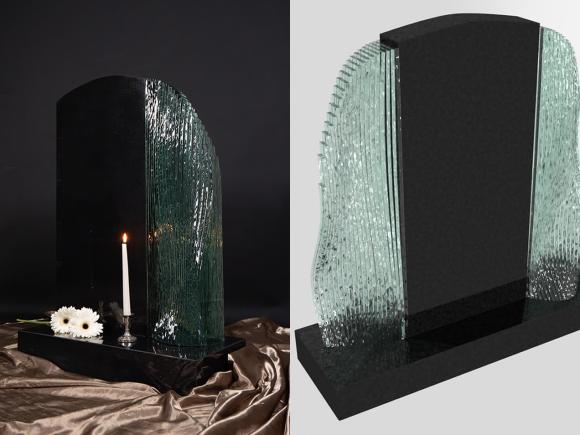
In Latvia, the tradition of grave landscaping has deep historical roots. Creating a beautiful, well-kept and long-lasting memorial is a symbol of respect, love and eternal remembrance. Of all the materials that modern memorial architecture offers, granite monuments rightly hold the leading place.
In this article we look in detail at why this natural stone is considered the ideal choice, how to match colours and shapes correctly, and what to pay attention to when landscaping a family grave.
Why are granite monuments still the main choice in memorial architecture?
Most monuments in Latvian cemeteries are made of granite, and this choice is driven not only by fashion but also by careful practical considerations.
Granite is an igneous rock that formed deep inside the Earth over millions of years under enormous pressure and high temperatures. The result is a material of unique density and strength.
In Latvia's climate, with its temperature fluctuations, long autumns, high humidity, frequent rain and frosty winters, high-quality granite monuments are practically the only way to ensure that a memorial will last for centuries without deforming. The properties of this stone are impressive:
- Low water absorption. Granite is a natural stone with very low water absorption. This is especially important in winter – if water gets into the stone and freezes, it expands and damages the structure of the material from within. With granite of northern origin there is practically no such risk.
- High frost resistance. The stone easily withstands hundreds of freeze–thaw cycles while keeping its integrity.
- Resistance to the elements. The natural stone does not fade in direct sunlight, is not damaged by ultraviolet radiation, and resists scratches, wind-blown sand and the effects of aggressive precipitation.
In addition, the fine- and medium-grained structure of the stone allows craftsmen to carry out work of any complexity. Granite can be engraved to a high standard with inscriptions as well as intricate engravings or ornaments that do not fade over time and stay clear for decades.
The colour palette of stone: the most popular granite colours and their origins
The most popular natural stone materials for making monuments
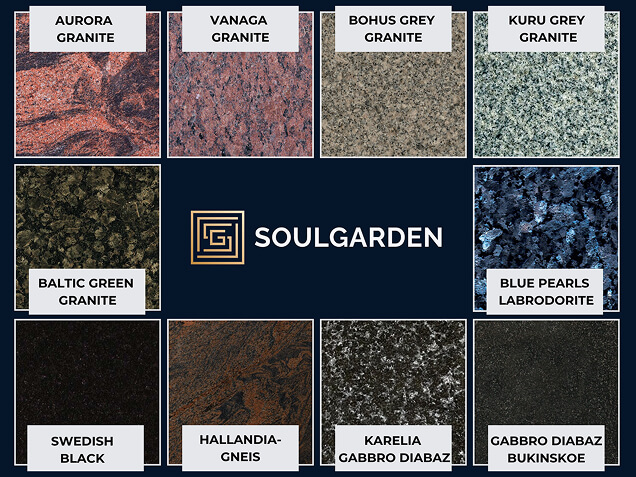
Memorial architecture can use granite in many colours, which helps avoid uniformity and gives a grave its own character. The most popular are black, dark and light grey, red-brown and reddish granite. SoulGarden also offers other granite materials, but these shades remain the most sought after.
Black granite – a classic, with the dignity of deep tones
Black traditionally symbolises mourning, respect and eternity. Engraved epitaphs and religious symbols look particularly striking against black granite. SoulGarden offers three proven types of black granite:
- Swedish granite (Swedish Black). Considered the benchmark of the highest quality. It has a deep, rich black colour with minimal inclusions and takes on a fine mirror-like shine when polished.
- Karelian granite (Karelia Gabbro Diabaz). A durable stone in a dark grey or black tone with fine light inclusions. It is known for its outstanding longevity and excellent qualities for engraved portraits.
- Ukrainian granite (Gabbro Diabaz Bukinskoe). It has a fine-grained pattern, a deep dark colour and an optimal balance of price and quality.
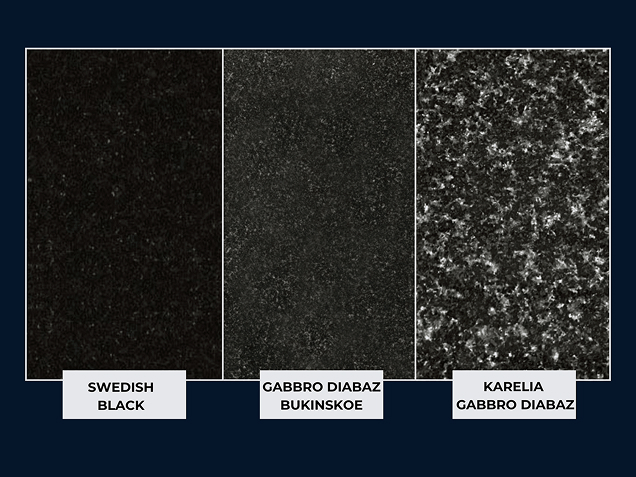
All three are high-quality natural stone materials. Each differs slightly in tone, texture and price, but all are ideally suited to the harsh Baltic climate, unlike, for example, black granite quarried in China or India.
The risks of Asian imports: why SoulGarden does not use granite from China and India
In recent years, cheaper monuments made from Chinese or Indian black granite have appeared on the market. However, SoulGarden deliberately chooses not to use these materials. The reason lies in the geological characteristics of stone of southern origin.
Granite quarried in warm countries is often more porous and contains more mineral inclusions of various kinds, including iron oxides. With Latvia's prolonged rain and frequent freeze–thaw cycles, these compounds can oxidise inside the stone. As a result, after only a few years a cheaper monument may become covered in rust stains, lose the shine of its polish, turn dull or develop micro-cracks.
At the same time, we do not rule out coloured Asian granite altogether. In memorial complexes, Indian granite in various shades can be used where the designer's concept calls for it. In this case, however, it is never a question of saving money – blocks of high-quality coloured granite from India cost as much as high-quality European raw materials and last just as long. Our aim is longevity, which is why we choose only proven and authentic materials.
Northern granites (from Sweden, Finland and Karelia) formed in completely different geological conditions, which is why they are stable and reliable and keep their properties for centuries.
Polished granite monuments
Polished granite monuments are the most popular grave landscaping choice today.
Polishing is not just a way of giving the stone an attractive appearance – it is an important part of the technical process. In the final stage the granite is ground with extra-fine polishing discs until its surface is completely smooth. Polished granite is much easier to look after, and it is also well protected against damage and the effects of the elements.
Professional mirror polishing completely seals the stone's microscopic pores, making its surface practically impermeable. Moss, lichen and mould do not form on such a surface, and street dirt, tree pollen and rain deposits are not absorbed into it. Any autumn or spring dirt can easily be washed off with plain water, without harsh cleaning products.
Aesthetically, polishing gives the stone a more striking and deeper look, creating a more elegant and distinguished memorial composition. It brings out the natural colour and texture of the stone – light is reflected from the mirror-like surface, revealing the depth of the rock's natural pattern and making the tone of the stone especially rich.

From classic to exclusive design: monument shapes and geometry
Modern stone-working technology makes it possible to give granite almost any shape. Granite monuments can be of many kinds – classic, abstract and of complex shape, as well as in the form of a heart, an open book, a wave or a flame.
Classic-shaped monuments
Classic rectangular or slightly rounded stelae never go out of style. They are suitable both for commemorating one person and for family burials (as a shared family monument). Strict geometric lines emphasise the dignity and monumentality of the memorial. Such shapes are versatile – they adapt easily to graves of different sizes and go well with traditional grave borders, granite borders and flower beds.
Complex, figurative and abstract stelae
If you wish to highlight individuality, express particular emotions through shape or symbolically reflect the life story of the departed, a figurative monument of complex shape is a suitable choice.
- A heart-shaped monument.
- A stele in the form of a book or parchment.
- Abstract and asymmetrical shapes.
Combining materials and decorating memorials
For grave landscaping to look harmonious, designers recommend creating a unified memorial ensemble. The composition can be made from granite of a single colour or combine several shades, most often in combinations of 2–3 colours. For example, deep black Swedish granite looks particularly elegant combined with a contrasting red-brown or light grey stone.
A wide range of natural stone is available for polished granite monuments – most often Swedish, Finnish, Karelian and Ukrainian commercial granite is used.
A good example is a family memorial complex in Swedish granite, where dark polished monuments of complex shape with a portrait are complemented by a partly closed grave slab and carefully laid granite chippings.

Worked and polished granite goes extremely well with other high-quality materials:
- With glass. A contemporary option is impact-resistant toughened glass elements set into a granite stele, with a high-quality colour print of a portrait or landscape.
- With marble. Snow-white marble elements, bas-reliefs or small sculptures create a striking contrast against dark granite.
- With metal decorations. Elements in wrought metal or high-quality Italian bronze (crosses, branches, flowers, letters, candle holders and vases) give a memorial a finished, rich and refined look.
Practical tips: how to care for polished granite
Although high-quality granite is extremely durable, correct and gentle care will help it keep its original mirror-like shine for many decades. Follow a few simple rules:
- Regular cleaning. A few times a year (in spring before the season begins and in autumn in preparation for winter) it is enough to wipe the polished surface with a soft cloth or sponge dampened with clean water. Afterwards, it is best to wipe the stone dry so that no water marks form.
- Do not use harsh cleaning products. You should never use household cleaning products intended for kitchens or bathrooms, especially those containing acids, alkalis or abrasive particles. They can permanently damage the polish, leaving it matt and rough.
- Removing wax. If wax from memorial candles has got onto a granite monument, do not scrape it off with a metal knife, a coin or a stiff brush. Carefully soften the wax with warm water, or wait until it has hardened completely in cool weather, then remove it with a wooden or plastic scraper and clean the area with a weak alcohol solution.
- Caring for engravings and portraits. Do not scrub engraved portraits and inscriptions with stiff brushes. They can be cleaned carefully with a damp, soft cloth without pressing hard, so as not to wash out the special paint that protects the engraving from moisture.
Creating a memorial that will preserve the memory for generations
Grave landscaping is a responsible, multi-stage process that requires a professional approach at every stage – from choosing a suitable stone to installing the memorial properly in the cemetery.
Mistakes in building the foundation, incorrect installation or choosing a poor-quality material (such as porous Asian granite) can cause the monument to subside, cracks to form and its appearance to be irreversibly spoiled.
By entrusting this important task to the SoulGarden workshop, you can be sure that the memorial complex will be made from certified European and Nordic granite of the highest quality.
Our skilled craftsmen will take all your wishes into account, help you combine colours and shapes harmoniously, carry out high-quality engraving and create a long-lasting memorial ensemble that will preserve your family's story with dignity for your children, grandchildren and future generations.
In addition, SoulGarden offers a full range of services – from regular grave care and professional grave landscaping to the development of individual 3D designs.
You will also find a wide range of grave accessories with us: crosses, granite borders and wrought metal elements.